Published September 2026 | Cain Beckett DLI FAICD
NESA (National Employment Services Association) | Peak body for Australia’s employment services sector
Welcome to my first blog post. I am really excited to be working with the team at NESA. I’m here to focus on strategy, particularly policy; and inclusion and disability employment more specifically. I’ll be your and NESA’s correspondent here in Canberra.
It would be great to hear from you if you have questions or topics you’d like me to explore in future posts.
But let’s talk about disability employment to kick this off.
I’ve been on my horse about it for some time I confess. It’s the one area of disability policy that really needs a spring clean.
When (all those years ago now), I joined the federal government to help build the National Disability Insurance Scheme (NDIS) it may surprise you that there were two key areas missing from the NDIS design trials. One was housing and the other was employment. I believed I used some choice phrases at the time about the two most important bits being in the too hard basket.
I’m not sure how this occurred, but with six months till the NDIS launched we only really had time to think about one of these. So, I took housing by the horns, threw out the old manual, and built something new. Specialist Disability Accommodation was born and the rest is history.
Employment supports never really got a guernsey, for me it has always felt like unfinished business.
Its an understatement to say that we really need to try something new for inclusion in employment. The figures are universally grim.
Bear with me while I nerd-out on some economist-style data points for a moment (and we need to get better at using governments own data to shift government thinking).
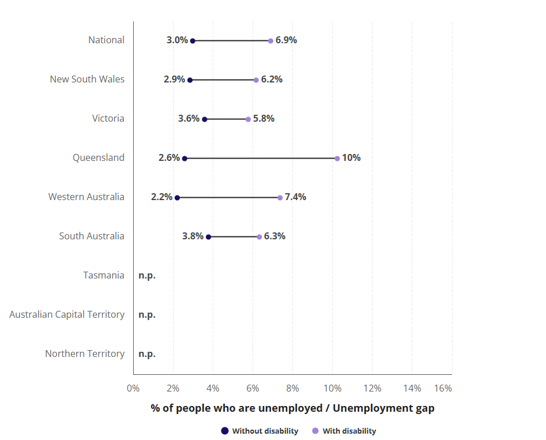
Economic participation and employment has been a feature of Australia’s National Disability Strategy since its inception. Yet despite our heartfelt and best efforts, the unemployment gap for people with disabilities has been stubbornly hard to shift. The latest report on our Strategy from the Australian Institute of Health and Welfare (AIHW) shows that we have achieved no meaningful change to this measure since 2018, and indeed really not much improvement at all since we started measuring in the first place!
Figure 1:
Indeed, of the 10 employment and financial security outcomes measures in the Strategy:
In another report from Skills Australia, data from the ABS highlights the unemployment rate of people with disabilities (7.5%) is more than double those without (3.1%), and predictably people with disabilities also make-up 28% of those in long term unemployment.
AIHW highlights also that the employment gap varies widely by jurisdiction. (Ref. Figure 1) Queensland you are really letting the side down!
Australia thus ranks 19 out of 32 OECD countries on disability employment. (Ref. Figure 2)
Figure 2:
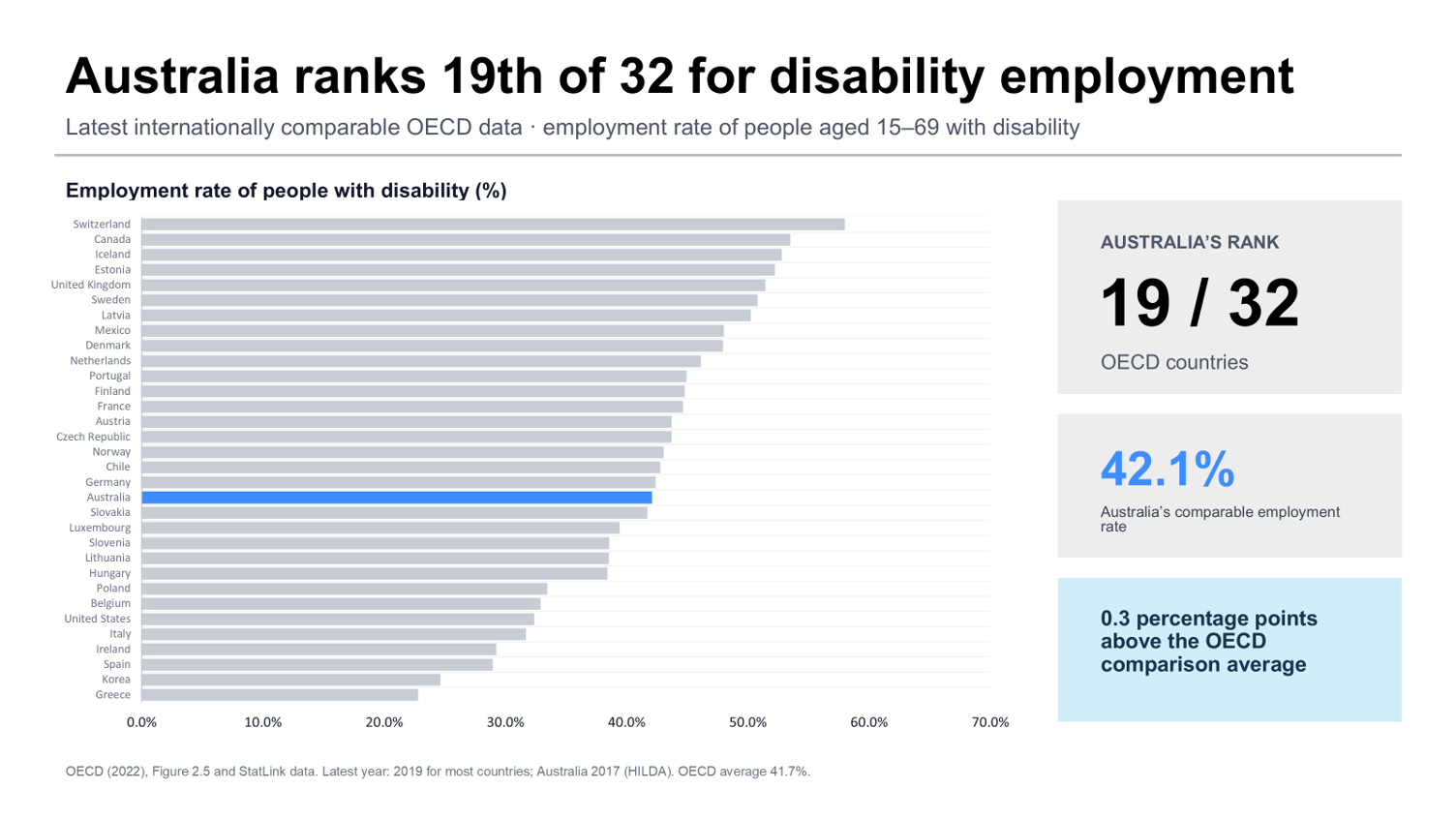
But it’s not just the fact that we are 19th that bothers us all. It’s that other countries are pulling further ahead. The scale of this challenge is chilling. I co-founded Australia’s research organisation focused on prevention of my particular disability, the Cerebral Palsy Research Foundation. Like employment, prevention historically hasn’t had enough focus, but the Foundation has grown to become the world’s largest private funder in its field, funding work in over 40 countries.
I mention this to set expectations that it is going to need transformation not just change if we are to take the hill on disability employment. Let’s not tinker at the edges.
Our strategy for prevention is working; but unless we change our disability employment strategy the Foundation will have cured my disability globally nearly 1000 years before we reach parity on employment.
Part of the reason Australia (and many other countries) is in a pickle when it comes to inclusion in employment is that we have historically focused on apparent deficiencies in the workforce and employees, rather than considering why employers don’t hire, or report that they struggle seeking to hire, people with disabilities.
Emma Bennison one of Australia’s most respected disability strategists, recently observed at the National Disability Employment Conference, that disability employment is “defined by what others imagine we are capable of doing, rather than what we can actually do”.
Graeme Innes AM, the former Discrimination Commissioner and Chancellor of UCQ describes this, succinctly as “the soft bigotry of low expectations”.
It’s the biggest problem in disability. I can feel Australia’s ~ 5.5 million people with disability all nodding furiously as I write this. We all experience this almost daily. I can conquer my disability, easily in fact. It is much, harder to change everyone else’s attitudes.
From an employment perspective then, policy approaches for 50 years have been focused on building skills and supporting employees, rather than opening doors, growing capabilities for employers to hire people with disabilities. A focus on one side of the equation means there are at least 260,000 people with disability ready for work, that aren’t employed.
Let’s be honest, even the most enlightened employers are nervous when it comes to inclusion. Maybe hiring people with disabilities is going to be expensive, that we are going to struggle to do the job, or be less productive, even though all the data in the world points to the opposite being true.
To get traction we need to change the focus to supporting employers to hire more people with disabilities, smooth over the barriers, and get more people with disabilities into open employment
Currently the combination of policies and programs comprising Australia’s disability employment system creates about 20,000 to 25,000 jobs annually (once we account for the high attrition of roles within the first year). That’s enough to keep pace with population growth but not much more.
Conversely, according to DSS, there are about 16,000 people (2023 data) in supported employment and that’s largely static.
The gap in the open employment rate of people with disability and those without translates to about 650,000 to 700,000 additional jobs.
To reach parity in disability employment in a reasonable timeframe, say by 2050, Australia needs to at least double the rate of job creation for people with disabilities before allowing for:
If I was in the boardroom of BHP or Westpac, and our strategy called for 100% improvement in performance, it would be readily understood that merely working harder on the status-quo is unlikely to be successful.
From an employment perspective we need to try something different to achieve this. NESA is building an industry-led program that aims to generate that 100% improvement in open employment outcomes.
We’re aiming for parity by 2050. That’s going to need everyone working together, employers, employment services organisations, and specialist disability organisations all pulling in the same direction.
We will share more information as this program progresses, but early discussions with key stakeholders have been extremely encouraging.
Author : Cain Beckett is the Executive Advisor on Strategy and Inclusion for the National Employment Services Association. He has been a Fellow of the Australian Institute of Company Directors for more than 15 years and currently serves on the boards of Aruma Disability Services, Attain HealthTech, Mable and AbilityMade.